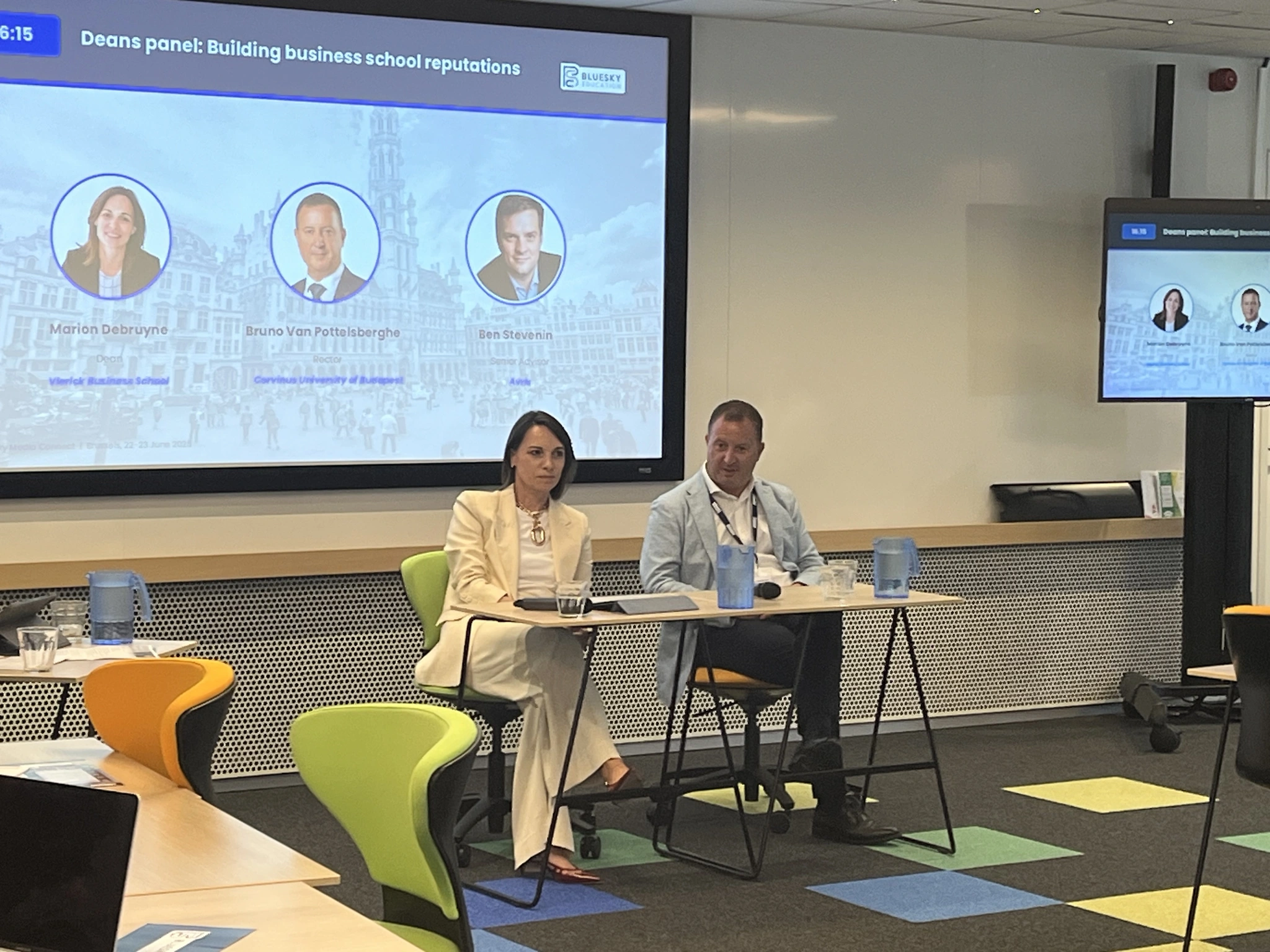
Media dynamics under the microscope at Brussels conference
One of the main issues at play when it comes to dealing with the media as a business school dean is that “we’re academics who have spent a long time studying one particular subject, where everything has been proved by rigorous research, but you need to move away from that perspective to become an all-rounder”. This was the point made by Vlerick Business School dean Marion Debruyne (pictured above left) during a panel session at the Media Connect conference, held at the school’s Brussels site in late June.
Also on the panel was Bruno van Pottelsberghe, rector of Corvinus University. He noted how “it’s a challenge to get the media interested in your story and to best understand how to promote [your offering] and measure [engagement]”. Van Pottelsberghe also suggested that the media are not always interested in high-level research results and that applied research on “hot topics” (ie those of interest to the public) is more often sought after.
Aiming to achieve media coverage
Debruyne agreed that it could be an uphill struggle to achieve consistent media coverage, noting that it often comes down to choosing the correct spokesperson. “Some faculty enjoy engaging with the media – they get it, they’re good at it and like to be quoted.”
On that note, Van Pottelsberghe recalled the instance of a top scientist at a German university whose theoretical research was brilliant, but as the subject was extremely complex, “nobody wanted to interview him, so he lacked wider recognition”. He also highlighted the important role that professional staff play in achieving coverage for a business school. Debruyne added that her background as a professor of marketing means that she has “a natural affinity” for interacting with the media.
How to ensure an authentic business school strategy
Turning the conversation to strategy, Debruyne acknowledged that it can be hard sometimes to tell one business school mission statement from another: “I know my strategy is right because my competitor has the exact same one”, she joked. In her opinion, the way to make it more authentic, thereby differentiating your school’s offering, is to focus on what it does best; in the case of Vlerick she commented that this would be entrepreneurship.
In a follow-up discussion after the panel, Debruyne elaborated on some of these points, remarking that “today’s education leaders need to be diplomats. You have to be able to navigate paradoxes, tensions and contradictions”. She used the word “glocal” to highlight the way that deans need to “have a world view but also serve their local community”.
She added that while school heads are trained as experts with a narrow focus, there is a much broader set of issues, around AI and sustainability for instance, that they will be expected to address, so “they need to get comfortable with that”. Asked about the ubiquitous influence of the new-gen technology, she referenced “the duality – our students strategise with AI, but we hugely embrace human-first skills too, it’s not a case of ‘either/or’, but both [matter].”
Why geopolitics is shaping boardroom conversations
Looking at the way that current boardroom conversations are increasingly shaped by geopolitics, Debruyne said it was hardly surprising given how global power dynamics have impacted on the corporate supply chain. “The war in Ukraine, the Iran conflict, economic tariffs imposed by the US – CEOs must be knowledgeable [about such things] and learn to integrate these into their business strategy”.
She also highlighted the importance of scenario planning: “embedding uncertainty wasn’t that relevant a decade ago but now it’s essential, as these conflicts create tension and leaders [across both business and education] feel under pressure to speak out”.
Breaking down the Bridge Strategy at Corvinus
Meanwhile, Corvinus rector Bruno van Pottelsberghe expanded on the university’s Bridge Strategy. “We used the image of the Budapest bridges as they are a symbol of dynamism and connect the present to the future”, he explained. The initiative is designed to run until 2030 and “significant progress” has already been made.
The Corvinus rector outlined the four pillars as follows:
Tram 2: Commitment to Multidisciplinarity
Flight 6: International & Corporate Exposure
Intercity: Student-Centred Culture & Journey
The Ring: Strengthening Research Activity
The ultimate target underpinning these pillars is to leverage Corvinus’s unique geopolitical position where East meets West, aiming to place the university among the top three in Central and Eastern Europe, as well as becoming a top 50 European business school.
Implementing a dedicated focus on the student community
Under the student-centric pillar, Corvinus has introduced a dedicated vice-rector of student affairs, a role designed explicitly to treat the student journey with the same level of professional talent management as a top-tier corporate firm would provide to its employees. As van Pottelsberghe was at pains to point out: “This is the first of its kind in Hungary”.
Another key goal is to diversify income, with the lifelong learning function playing a central role in this regard as it continues to “grow in the right direction”. SEED Executive School (originally founded as the School of Executive Education and Development), previously an independent, highly regarded corporate training business school operating in Central and Eastern Europe, has now been incorporated into the university.
Internationalisation is another talking point: van Pottelsberghe stressed that the aim here is “not to replace local students but increase diversity and the multicultural experience”. He acknowledged that “not all the academic community is open to [the prospect of] internationalisation”, but pointed out that Corvinus remains “primarily Hungarian – only around 25 per cent of our students are currently from overseas, meaning that at least 75 per cent are still local”.